
For 58 years, the Federation of Southern Cooperatives/Land Assistance Fund has worked to save Black-owned farms and land. Born out of the Civil Rights Movement, the Federation exists for one clear purpose: to ensure that Black land remains in Black hands.
The organization’s charter is held in Washington, DC, but its work is rooted in Southern soil. Staff operate across seven core states that include Alabama, Florida, Georgia, Louisiana, Mississippi, South Carolina, and Texas. They support more than 1,000 landowners whose holdings vary widely in size and use.
In a recent webinar titled The Land That Held Us, founding member John Zippert and current leaders reflected on the origins of the Federation’s Rural Training and Research Center. Black landownership traces back to the U.S. government’s promise of “40 acres and a mule”, this was a commitment made during Reconstruction and swiftly rescinded by President Andrew Johnson. Despite that betrayal, Black families continued to acquire and defend land as a foundation for autonomy. Securing land during the Civil Rights era was not incidental. It was deliberate. Land meant protection from retaliation. It meant space to organize. It meant economic independence in a system that systematically excluded Black farmers from credit and federal support.
Over time, the land acquired by the Federation evolved into a permanent hub for cooperative education, land stewardship, and organizing. The Rural Training and Research Center became infrastructure for freedom work — a gathering place where farmers could navigate heirs’ property challenges, strengthen estate planning, build cooperative governance, and learn across generations.
Briar Blakley, Director of Communications and Member Relations, describes the stakes clearly. An activist and multidisciplinary professional, Briar’s work centers on amplifying marginalized communities and confronting the systemic realities of Black land loss.
“In 1920, Black families owned roughly 15 million acres of land across the South,” Briar explained. “By 1960, that number had dropped to about 6 million acres. Today, it is estimated at closer to 3 million acres.” That decline reflects decades of discriminatory practices such as partition sales, tax sales, adverse possession, and the ongoing complications of heirs’ property.
Heirs’ property remains one of the most destabilizing issues. When land is passed down without clear legal documentation, it becomes vulnerable to forced sales, often at below-market value. Families face rising property taxes, limited access to capital, complex legal systems, and pressure from developers or extractive industries.
The Federation’s response is collective.
“Farmers operating alone often face limited market access, restricted credit, and vulnerability to unfair pricing and exploitation,” Briar shared. “Cooperation allows farmers to pool resources, share knowledge, and strengthen their collective bargaining power.”
Through the Federation’s Heirs’Property Boot Camps, Wills Clinics, coordinated outreach, and technical assistance, the Federation helps families clear title, retain ownership, and steward land productively. Cooperative structures allow farmers to access broader markets, secure financing, and advocate in larger numbers.
Support also moves across generations. Many members represent second- and third-generation cooperative participation, learning from elders and passing knowledge forward. Convenings and training sessions create space for peer learning, collaboration, and mutual aid.
Beyond its members, a broader network of partners, advocates, and donors strengthens this work. This network is investing in the Federation’s Capital Campaign, expanding the Revolving Loan Fund for land retention and cooperative development, and sustaining the Rural Training and Research Center as a permanent home for movement infrastructure.
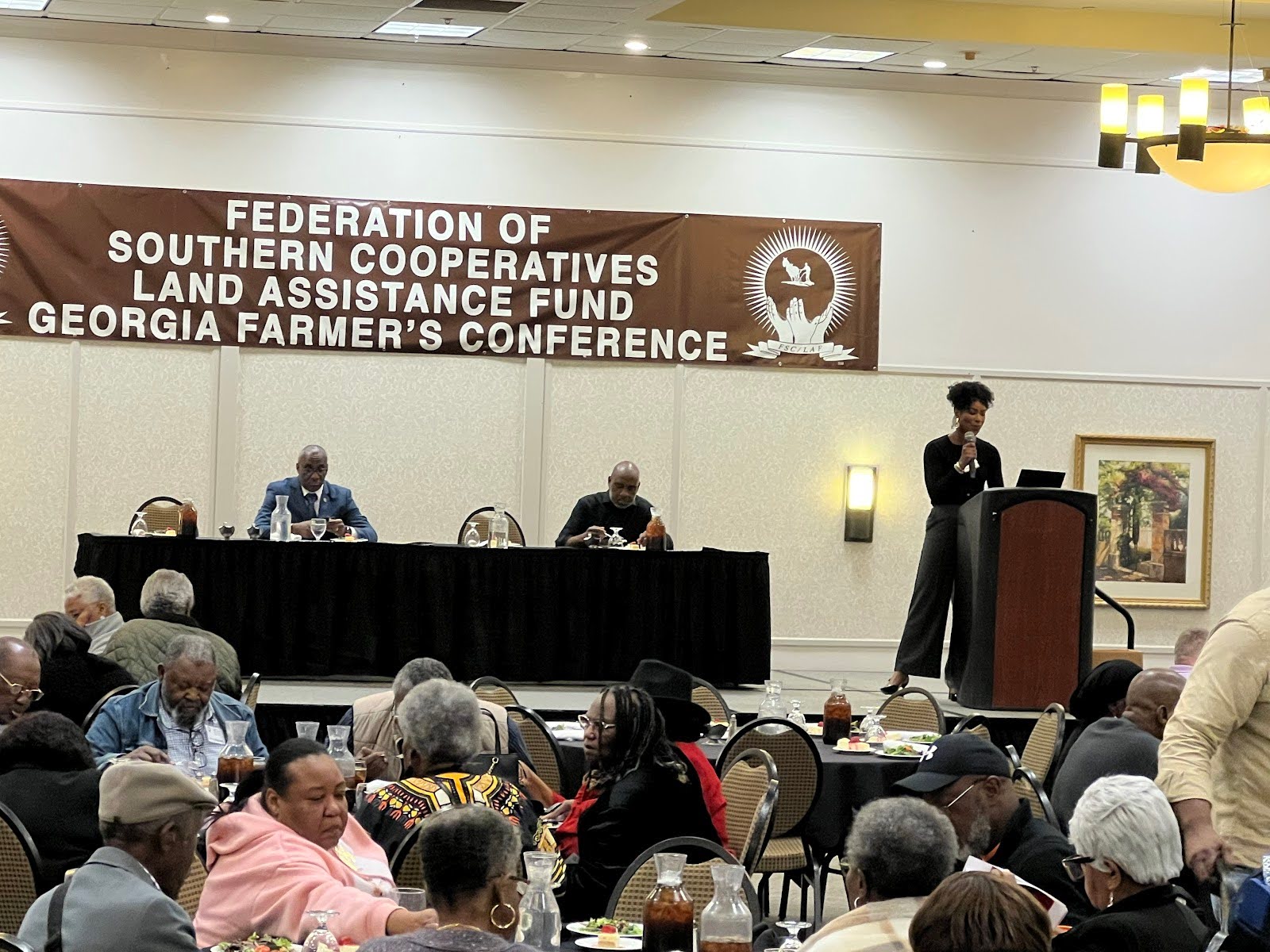
At the Georgia Farmers State Meeting in Albany this February, that continuity was visible. Farmers gathered not only to address land retention and federal programs, but to reaffirm relationships built over decades.
The Federation’s work reminds us that cooperative economics and land stewardship were central to freedom struggles in the past — and remain essential today.
