
Keralam is a state in India rich in wetlands and home to fragile ecosystems. In recent years, the state has faced so many challenges, including high population density, land scarcity for food production, and the depletion of natural resources. The grave challenge of solid waste management is adversely affecting the population’s well-being. When plastics enter the soil, they contaminate not only the soil but also water bodies, thereby affecting the overall well-being of the population.
Haritha Karma Sena: The Green Army
Haritha Karma Sena (meaning Green Task Force), a vibrant pool of trained personnel, was formed under an innovative state initiative called Haritha Keralam (Green Keralam), launched by the Government of Keralam in 2017. It has paved the way for addressing the serious challenge of collecting and processing non-organic waste. The state’s local self-government institutions have engaged members of Kudumbashree, a women’s collective with more than 4 million members who engage in microfinance, microenterprise, and livelihood activities.
The idea of Haritha Karma Sena was conceived as a microenterprise model run by the women members of Kudumbashree. This army of women, known as green volunteers, consists of more than 36,000 warriors waging a constant battle against the never-ending challenge of waste generation in both urban and rural areas. The members of the Sena play a critical role in the systematic collection of inorganic waste from the surrounding areas. Each member is assigned to collect inorganic waste from around 250 units, including households and commercial establishments, each month.
The Sena collects inorganic waste because, by design, the organic fraction never enters the collection stream at all. Kerala treats biodegradable waste at source, in the household that produced it. Through the Suchitwa Mission, the state’s technical support agency for waste management, local self-governments subsidise domestic treatment devices: pipe and ring composts, kitchen bins, vermicompost systems, and small biogas plants. Institutions and bulk waste generators such as hotels, hospitals, schools, and malls are required to install their own on-site organic waste converters. Where density or lack of space makes household treatment impractical, community-level facilities fill the gap.
What comes out of these units does not disappear. Much of it goes back into the soil of the household that made it. Kerala’s terrace and homestead gardening movement has grown alongside the waste programme and draws on the same state support, with subsidies for grow bags and planting materials and extension advice through local Krishi Bhavans. The loop is measured in metres rather than kilometres: kitchen waste becomes compost on the same roof where it becomes vegetables, often timed to the Onam harvest. In a state where land for food production is scarce, that is not a lifestyle gesture. It is agriculture.

Members of Haritha Karma Sena in Action
Integration with Technology
The women’s activities are streamlined through a mobile application (Harithamithram, meaning “friend of the Green Initiative”). A striking feature of the initiative is its linkage to technology. The mobile application tracks the efficiency of door-to-door waste collection, the billing process, and grievance redressal through digital channels. The women are given training to operate the application using a smartphone. Updates on waste collection and bill payments are communicated to the beneficiary via this digital channel.
Workflow of the mobile application of Haritha Karma Sena
For the collection of inorganic waste, the user fee is set by the respective local self-bodies; it varies according to geographical coverage and viability. Typically, a minimal amount of Rs is collected. Rs. 50 per house, per visit, per month, and Rs. 100 for commercial establishments. The members collect the user fee from the beneficiaries and record it in the mobile application. The fee is also linked to the local tax collection mechanism. If a beneficiary defaults, the unpaid fee is recovered from the beneficiary in due course through the local self-government’s tax collection.
Livelihood assurance
Monthly salaries for members are paid from the user fees. An average of Rs. 8000 (around US$90) is disbursed to each volunteer per month. There is variation in housing density and the locality of activity across the local self-governments. Members in urban areas earn more than those in rural areas because the density of housing and commercial establishments is higher. The members also earn more when facilities for sorting and segregation are available in the locality. Hence, the initiative is considered a sustainable model because members receive income systematically and the system runs smoothly.
The local self-governments further facilitate the work by providing vehicles to transport waste from houses and commercial establishments to the material collection facility (MCF). The waste is then segregated and sorted, and reusable materials are taken to the resource recovery facilities (RRFs). These facilities, which help channel materials back into the circular economy, are also maintained by the green volunteers. The whole effort to facilitate the circular economy at the grassroots level is decentralization in the true sense, fueled by a massive effort led by committed women members.
Many members of the force come from marginalized sections of society. Latha, aged 54, who underwent angioplasty a few days ago, is back at work thanks to the support of her fellow members. In the field, members work in clusters of two or three. This arrangement ensures that if one person falls ill or faces an emergency, another member will carry out the activity without interruption. Latha uses the income from this work to pay for her treatment and support herself. The women are also covered by health insurance and other benefits.
A consortium fund is also maintained as a common fund for each local self-government, fully devoted to the Haritha Karma Sena, with members remitting the user fees collected from beneficiaries. Ninety percent of the user fees are allocated to the salaries of green volunteers, and the remaining 10 percent is kept as a reserve fund. The reserve fund is used to buy safety equipment for the volunteers. It is also used to purchase uniforms, boots, gloves, and other items according to members’ needs. Any remaining funds are disbursed as a bonus during the festival season. One of the members said, “I will receive Rs. 15,000 as a bonus. I will use it for my daughter’s education, as she is enrolled in a dialysis technician course.” In total, Rs. 278,618,480 has been disbursed to the members of Haritha Karma Sena throughout the state since the program’s inception.
Circularity of Waste
The members collect all kinds of discarded materials, including clothes, footwear, old bags, used glass bottles, and plastic bottles. They segregate the waste and recycle it so that it becomes part of the circular economy. Until 2024-25, 11,802,665 metric tonnes of segregated plastic were collected, and 3,709 metric tonnes of shredded plastic were produced. The public works department constructed 7,249 km of roads using shredded plastic. In addition, plastic bottles are repurposed into flower pots, plastic chairs, and other useful items. The legacy waste is also used to produce Refuse-Derived Fuel (RDF), which replaces coal, a fossil fuel, in cement production. Recycling and the addition of economic value are integrated throughout the process to ensure sustainable operation.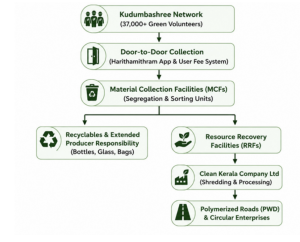
Workflow on the functioning of Haritha Karma Sena and its integration into the Circular Economy
Social Recognition
The commendable work of the members has received social recognition, which members consider one of the most important benefits of their work. Pushpa, aged 39, said, “Earlier, we were called ragpickers. We are now known as green volunteers. The people wait for us to come to their houses. They keep the plastic covers and other rejects in the manner we need to collect them. We are a highly welcomed guests nowadays.” The members are considered crucial service providers at the local level. This is a very good example of how women’s dignity and social standing in local communities can improve through meaningful work.
A health inspector, who oversees operations in an urban local body, observed: “The Haritha Keralam initiative has enhanced awareness about waste segregation and waste disposal among the general population. Nowadays, people won’t dispose of waste haphazardly. This has reduced the incidence of communicable diseases, too. However, the occupational safety of the members who engage in the activity has to be ensured and needs to be carefully looked into.”
Conclusion
Waste was once a problem for everyone. It was a threat to the environment. But it has become an opportunity. Haritha Karma Sena has allowed thousands of women to enter the public arena and play a vital role in the circular economy, while also ensuring sustainable livelihoods. The state’s economy benefits as circularity works, local communities are waste-free, and the soil is not choked by plastics. Traditionally, women have engaged in cleaning the house and neighborhood, work which was traditionally unpaid. Here, upgrading that role into paid work and integrating it into the circular economy are both remarkable and meaningful, in both economic and environmental terms.
(Note: Names have been changed to protect participant confidentiality.)