
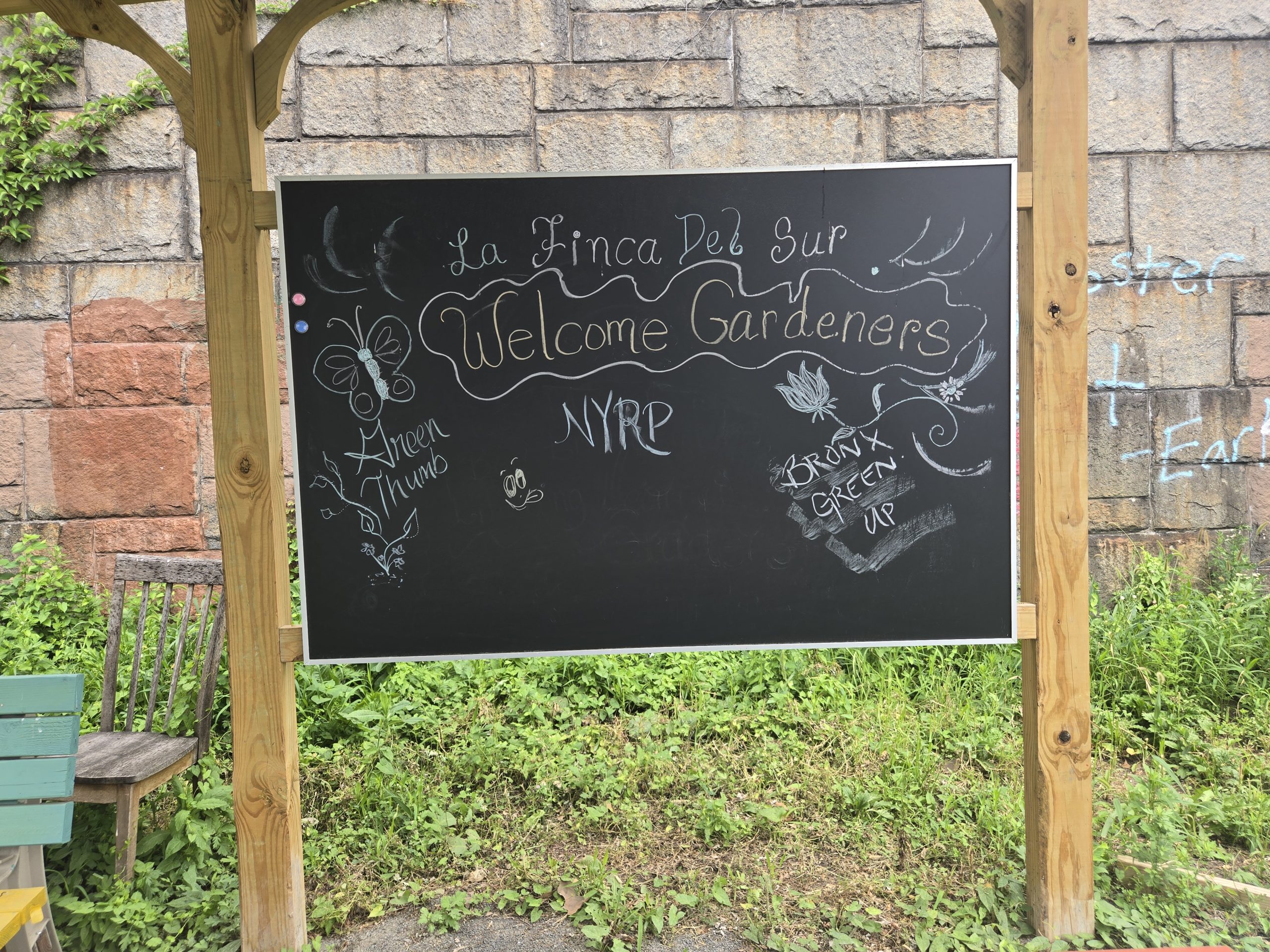
Low clouds hung overhead as I arrived at La Finca del Sur on a Saturday morning in July. The garden was already bustling. I was greeted by Sam, one of the members, who welcomed me warmly before putting me to work alongside other volunteers. Through a chain-link fence threaded with climbing vines, raised beds stretched out in every direction: kale, tomatillos, papalo (cilantro-like plant indigenous to central/ south America) , collard greens, herbs whose names I didn’t know yet. A folding table near the gate was being arranged into a farmers market, modest and unhurried.
I spent the morning doing what everyone else was doing: harvesting, washing, and bundling collard greens and kale for the weekly market. It was my first real look at the labor that sustains a place like this, how much goes into a Saturday morning before the gates even open.
The Farm Itself
La Finca del Sur, “The Farm of the South,” has stood on this plot in Mott Haven for 17 years. It was founded by five women of color, Black and Latina, who looked at a weed-choked lot in one of the most underserved neighborhoods in New York City and decided to build something.
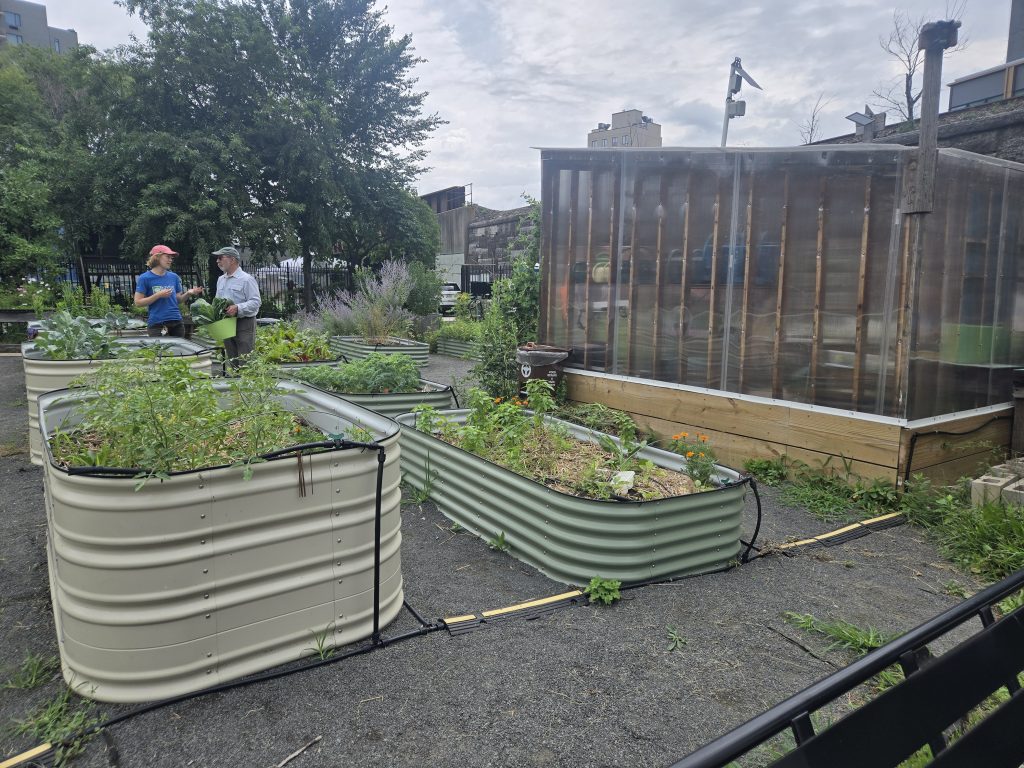
Two acres sit beneath the elevated subway tracks, making it one of the largest community gardens in the Bronx. Last year, the New York Restoration Project (NYRP) undertook a full restoration: new raised beds, regraded pathways, a greenhouse with a whiteboard where the week’s tasks are listed out in marker. The day I visited, a NYRP representative was leading a workshop on pesticide use and sustainable gardening practices.
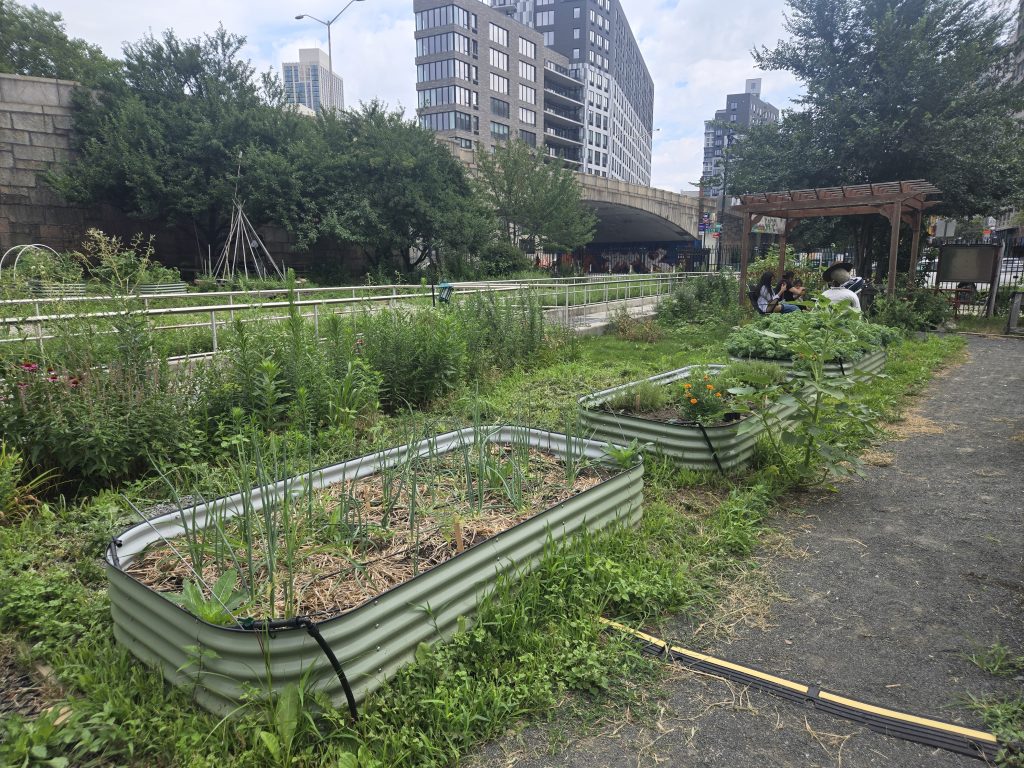
Alan Markowitz has been a member for six years and serves as the farm’s resident beekeeper, a role he essentially created himself after 25 years of keeping bees and eventually talking the farm into hosting hives. He describes the farm’s transformation with obvious pleasure: “People look in here and they see this, and they’re taken aback at how gorgeous it is.”
Mid-conversation, he paused to point out a family settled on a bench nearby, a little girl who, he said, comes regularly with her parents to color and play. “That’s what we’re here for as well,” he said.
Between tasks, I wandered through the growing beds, photographed the space, and talked with members about what brings them here.
What People Find Here
Martina found La Finca on Instagram a few months ago. She came during open hours, showed interest, and became a member almost before she realized it. She was there that Saturday with her daughter Amalia, three years old and the farm’s youngest gardener, who has already helped plant seeds in the children’s bed near the fence. “It’s kind of like a safe haven,” Martina told me. “Very relaxing.” Before this, she’d never gardened. The farm is teaching her, and she’s trying to build on what she’s learning. At home, she said, she’s started rethinking how she cares for her houseplants.

Yanlin lives within walking distance and started coming in June, after months of making the longer trip to Randall’s Island Farm on Sundays. She talked about what urban agriculture actually means to her, in practice and in everyday life. “Most of us living in urban places, we only have access through supermarkets,” she said. “And the supermarket food, they’re not, like, real, real produce. They’re selected for easier transport. Not for nutritional value. Not for flavor.”
She said working at La Finca is grounding. She meant it literally.
Today Alan was also setting up for a beekeeping lesson with a group of young adults from Bee University, a youth organization that pairs food justice education with hands-on agricultural training. They would go into the hives together and talk about what they see. “Plants are a wonderful thing,” he told me, kneeling near a bed dense with kale. “They know how to grow once you stick them in the ground. So don’t worry about the finer points of things. Just get the things in, pull the weeds.”
Food Sovereignty in Practice
I sat down with Nancy Ortiz-Surun, one of La Finca’s co-founders and its farmer coordinator. She was careful to distinguish what the farm does from food charity. The South Bronx has no shortage of food giveaways, she said: pantry distributions, bags of groceries delivered from somewhere else to people defined by their need. “That’s great, but that food is not being produced in the community.”
What La Finca offers is different. Food grown here, by people from here, sold at modest prices at a market held here. Workshops taught by people who know the soil like Demetrio, Nancy’s husband and co-founder, who grew up farming in the Dominican Republic. Alan and his bees. Immigrant farmers who brought tomatillos, papalo and Mexican herbs that are now part of the farm’s regular harvest. Nancy said “when you sell this at your market and people hear there’s papalo, there’s tomatillos, then they come, and they purchase, and they may become members.”
Nancy, who grew up Puerto Rican in the Bronx, learned to prepare collard greens at La Finca. She learned to make pesto. She learned the names of herbs she’d never encountered before. “We all started from agricultural knowledge,” she said. “But many people are distanced from it.” The farm is, among other things, a place where that distance gets closed.
What It Asks of the City
The farm runs almost entirely on volunteer labor. “The administration happens in our homes,” Nancy told me. No grant-writing team. No paid office staff. The farm is open when members can be there to open it. The market runs when people show up to run it.
She named the structural gap plainly: “This nation, and this city, knows that community gardens and community farms add to the health of the community. The maintenance of these spaces needs reliable support.” She is asking for acknowledgment of what is already proven: that a plot of land, tended by people who live nearby, can become a place where food is grown, knowledge is shared, loneliness is interrupted, and community is made.
Her dream, she said, is that La Finca will be here as long as New York is here.
As I was getting ready to leave, someone handed me two ripe plums picked fresh from one of the garden’s trees. It was a small thing. But it felt like the right way to end a morning at a place built on generosity.
La Finca del Sur is located at 175 East 138th Street, Mott Haven, Bronx. Accessible by the 6 train (138th Street–Grand Concourse station). Find them on Instagram @lafincadelsurbx or at lafincadelsur.com. Members and volunteers are welcome.