
Gavin Raders has been part of the Food First family for longer than this conversation. After contributing to our Amplifying Grassroots Voices in Food Justice project and graphic novel and more than a year of emails back and forth, sitting down with him live, even over Zoom with him scrambling for headphones at a cafe in Oakland on a busy Friday morning, felt like finally catching up with someone we had been meaning to call. The warmth was immediate and so was the clarity of his thinking. What follows is drawn from that conversation.
Planting Justice’s East Oakland headquarters sits at the end of 105th Avenue, in the neighborhood of Sobrante Park. As 105th Avenue runs south and east, it gradually feels less like an urban thoroughfare and more like a road entering a completely separate part of the city. At its terminus, the avenue dead-ends into a neighborhood bounded by industrial corridors, railroad tracks, and the channel of San Leandro Creek, a corner of Oakland with its own unique look and feel.
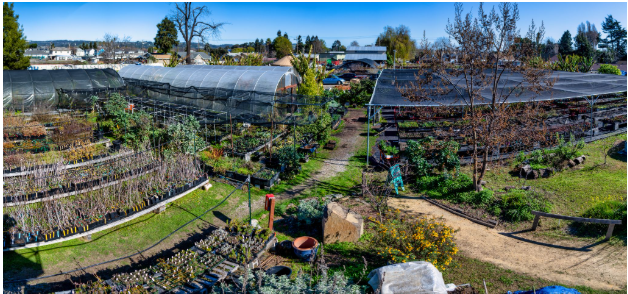
It is here, in contrast to its surroundings, that Planting Justice has built a 2 acre organic nursery, by and for local residents, growing over 1,500 edible plant varieties alongside something harder to quantify: economic justice, healing, and the right to come home. A few hundred feet away, three acres of construction are slowly taking shape: an aquaponics cooperative incubator farm that will grow 180,000 pounds of produce a year and, more importantly, train people to own the farms that feed their communities.
Co-founder Gavin Raders has been building here since 2009, when he and co-founder Haleh Zandi were coming out of anti-war organizing and spending time with people incarcerated at San Quentin. What they saw inside stayed with them: the relief people felt from simply having access to soil they could get their hands on and plants they could grow. And what they heard, again and again, was what people wanted to do when they got home.
“Some of our relationships with people began while they were still incarcerated. The dreams that folks would have behind bars about what they wanted to do when they got home, those conversations were happening before people got home.”
Those conversations became Planting Justice: a full-time, living-wage employer and reentry organization now led entirely by formerly incarcerated people and their families. All of Planting Justice program sites run without Raders’ direct day to day involvement. “My role continues to be leveraging resources and relationships to get support to the most impacted people, so they can do the work they know they need to do.”
Raders is clear-eyed about his own role. “As somebody who presents as a white person and has all of the unearned privileges in a white supremacist society, it’s been my role, my place to just be a space-maker. To create space for people to be able to do this work themselves.” Leveraging fundraising capacity, relationships, and access to resources that communities in Sobrante Park have been systematically denied: that is what Raders sees as his contribution. The work belongs to the people doing it.
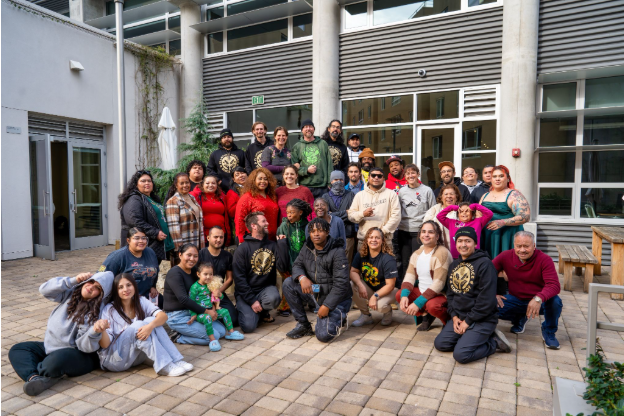
In 16 years, Planting Justice has created 250 jobs, employed 140 formerly incarcerated people full-time, and returned over $9 million directly to the Sobrante Park community through wages and mutual aid. Average pay for its 48 full-time employees is $31 an hour. And the organization is proud of its reentry staff 2% recidivism rate, which is significantly better than the California statewide rate of 39.2%.
Recidivism is by Design. So is Freedom.
When reflecting on what drives their success, Raders does not point to programming or philosophy. He points to the system.
“Recidivism is by design,” he says plainly. “When people come home, it is obvious that people are going to go back.” People cannot secure stable housing or employment. The probation and parole system sends people back, often not on new charges but on technical violations they could not afford to meet. Addiction and economic desperation fill the gaps. “The things available to people to survive are often things that are illegal.”
“If recidivism is by design, then its inverse, freedom, is by design too. We need physical spaces and models that people can see, smell, taste, and connect with.”
This is why Planting Justice describes itself as an abolitionist organization, drawing on Ruth Wilson Gilmore’s framing that “abolition is about presence, not absence. It’s about building life-affirming institutions.” Planting Justice is one of those institutions. Its nurseries, farms, a farmers’ market, a pay-what-you-can cafe, healing gardens, youth internships, reentry programming, and now an aquaponics cooperative, are all built as a single living ecosystem.
A Slow-Moving Genocide
The work is heavy. Staff in Sobrante Park have described the conditions in their community as “a slow-moving genocide” according to Raders. Members of the Planting Justice family have been killed by gun violence outside the nursery. People have fallen back into addiction. Friends and family members have been lost too young, too soon.
Raders is candid about the toll. “The ongoing trauma of this economic system, of living in a white supremacist society for Black and brown people coming home, is continuous.” Even people with a well-paid, meaningful job working alongside friends still carry that weight outside the gate. “Those things are ongoing.”
Raders speaks about his own mental health with the same directness. Growing food and medicine for himself is part of how he maintains his sanity. “Connection to land, to ancestors, to my spiritual being, that is a human right.” He watched too many activists burn out before Planting Justice existed. “So much anger and pain and fear about the world, which is all real. How to transmute that energy in a healthy way, that is something I do for my own survival and wellness, too.”
“We’re really just trying to be a rock that our people can hold on to in tough times.”
Owning the Land, Owning the Future
Sixteen years in, Planting Justice is entering what Raders calls a pivotal chapter. The El Sobrante Nursery and Farm Store, which opened in 2025 at 5166 Sobrante Ave, transformed the former Adachi Nursery site into a vibrant community space: abolitionist art installations, solitary and healing gardens, a pay-what-you-can cafe, a community art space, a commercial kitchen, and the first farmers’ market in El Sobrante. The Mother Farm in El Sobrante stewards over 1,200 varieties of fruit and nut trees on four acres, collaborating with Sogorea Te’ Land Trust and Agroecology Commons.
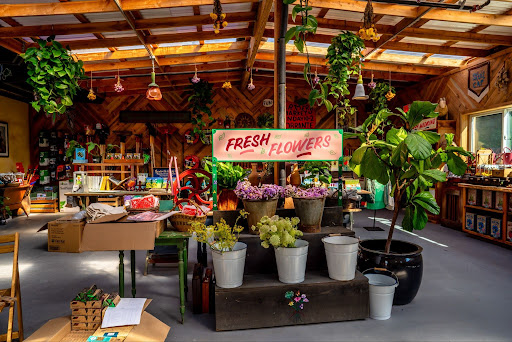
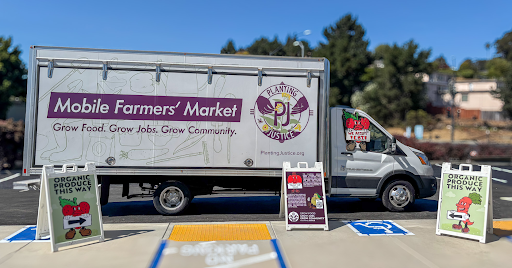
Construction is underway on the aquaponics incubator farm, where Planting Justice staff are training with the University of California Davis Aquaculture Cooperative Extension to learn the skills needed to run the system. Once complete, the facility is expected to produce 180,000 pounds of food and 150,000 young plants for transplanting each year, using 80% less water than in-ground farming, and built to withstand fire, heat, drought, and flooding. More than a farm, it is a training center and business incubator: Raders envisions training enough people to eventually support 10 to 20 worker-owned aquaponics farms across East Oakland, a model of land reclamation for residents who have lost land and homes to mass incarceration and economic hardship, with no university expertise in planning, zoning, or finance required to get started. The plan is to organize these farms as a multi-site cooperative, similar to dairy co-ops in the Midwest, so that individual growers do not have to compete with one another or shoulder the burden of marketing, financing, and distribution alone. Instead, produce would be sold together to larger buyers like universities, school districts, or hospital systems, with a buyer already lined up before a single seed goes in the water. Raders is candid that this is a long-term undertaking, describing it as a five to fifteen year process: building the first farm, proving the model works, training others to run it, and then helping them scale onto land they will own themselves.
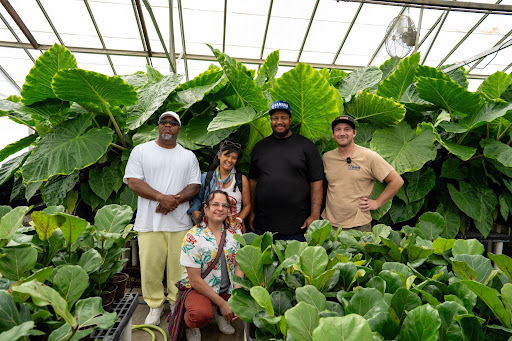
“This is one of many different strategies for land back in East Oakland, for East Oakland residents.” It is a ten- to fifteen-year process, Raders says without apology. “But this is where Planting Justice can be of service to something that could have a systemic, structural impact on our food system.”
“Abolition is about presence, not absence. It’s about building life-affirming institutions.” Ruth Wilson Gilmore
Planting Justice by the numbers
250 jobs created since 2009
140 formerly incarcerated people employed full-time since 2009
2% recidivism rate among formerly incarcerated staff (vs. 39.2% statewide)
$31/hour average wage for full-time employees
$9M+ returned to the Sobrante Park community through wages and mutual aid since 2016
1,500+ edible plant varieties cultivated at the East Oakland Nursery
1,000+ free fruit trees distributed to Oakland residents in 2025
760+ Oakland youth engaged through Planting Justice programming in 2025
180,000 pounds of produce projected annually from the Aquaponics Farm
Support Planting Justice
Visit Planting Justice’s East Oakland Nursery at 319 105th Ave, Oakland, CA 94603, or the El Sobrante Nursery and Farm Store at 5166 Sobrante Ave, El Sobrante, CA 94803. The nurseries sell fruit trees, native plants, and organic produce and the proceeds support reentry programs and cooperative development. Visit plantingjustice.org to learn more, donate, or get involved.
Images courtesy of Planting Justice. Photography by Birhon Quizhpe