
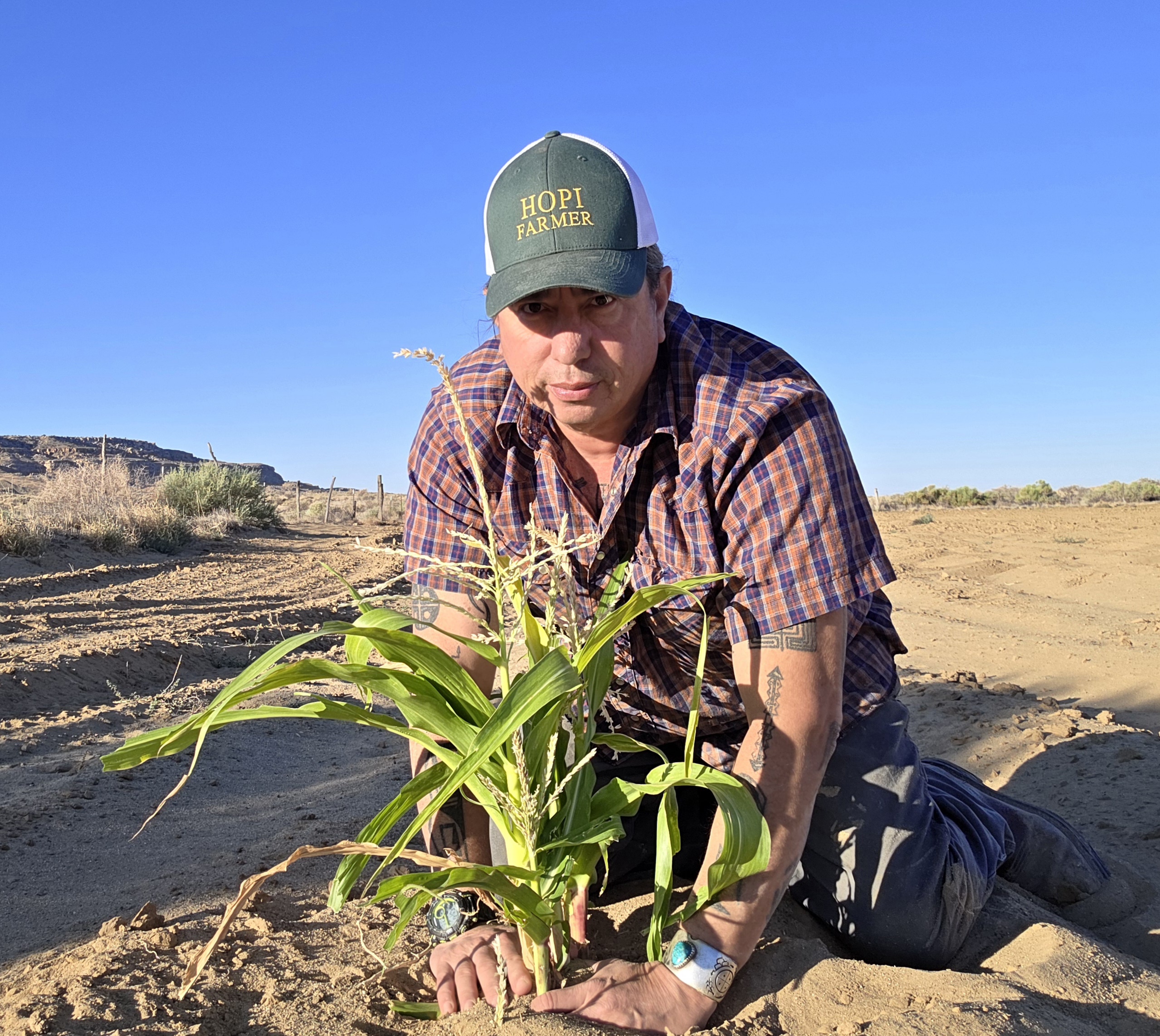
Corn at Hopi, like in some other Indigenous cultures in both North and South America, is commonly referred to as our “Mother” and is viewed as sacred. Over time, I have come to understand the importance of corn in my life and that of my people. Corn for this Hopi farmer is not a “commodity,” as it is often referred to in the news. No, it’s more than that; it is a gift. It is the establishment of a relationship like that of a son or daughter to their parents from birth to death.
As I got older and continued farming, I often heard the term “Mother Ear.” I asked a friend of mine and his wife what people meant by that. My friend’s wife looked at me and said, “The Mother Ear is a white ear of corn with kernels filled to the tip.” She said that if I found one, I should hold onto it because it was special. She said, “It signifies life and purity.” Since then, I have found a few “Mother Ears” in my fields over the seasons and have held on to them, but I have also given some of the Mother Ears to our Hopi women because they are commonly used in baby-naming ceremonies conducted by our people and also placed in the crib of a newborn infant.
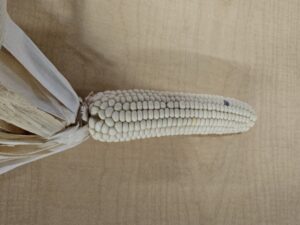
Image courtesy of Dr. Michael Kotutwa Johnson
At Hopi, we plant our corn deep, anywhere from 6 to 18 inches. The little seeds stay buried in the ground until they germinate, rise to the surface, and emerge like a newborn child. Seeing those seedlings come up from below brings me so much joy, comfort, and renewed faith. I am always out in my fields during the growing season, trying my best to protect my corn from harm. I often talk to and sing to my corn, encouraging them to grow strong.
I remember, as a young man, watching my aunt and her friends sit in the back of my grandfather’s house, located at the edge of the Hopi village of Kykotsmovi, sorting through the corn I brought in after our fall harvest. They would take the corn, remove the husks, and set the ears on a flatbed trailer to dry. As they prepared the corn for storage, they would sit and laugh, tell stories, and occasionally tease me for fun.
I remember helping the ladies once, and I found a few cobs that weren’t filled all the way with kernels, some really small or disfigured ears of corn, and I would place them on the side to be thrown away. After a while, my aunt came to check on me and told me, “Why are you throwing these away? We save those to eat. We don’t waste anything here, do you understand?” It was then that I began to understand the relationship we had with our corn. The understanding of this relationship is built on generations of knowledge, nurturing, and acceptance. I learned that as a society, we should not simply turn someone away because they may not seem useful or even different; we all have a purpose, just like the corn I was going to toss.
Today, when I plant, and whether I have a harvest or not, I am grateful. I am thankful for understanding the unique relationship we have with our corn and with our community. And like my plants, I hope to leave something behind for the next generation. My corn plants often leave ears full of seeds that represent new life and the next generation. The seeds I hope to leave represent laughter, hope, opportunities for others, but most importantly, faith. Faith, not for the things unseen, but the faith that reminds me to be grateful for just the small things in my life.
Finally, at Hopi, we have a saying, “We are like corn.” Over my years of life and many seasons of farming, I believe this to be true. Like a freshly planted corn seed that emerges from the ground, I will keep growing, maturing, and helping others learn to plant their own life’s seeds so they can experience the joys of their harvest and share what they’ve learned with their communities, thus shaping new meanings of relationships.
Author’s Bio
Dr. Michael Kotutwa Johnson is a member of the Hopi Tribe in Northern Arizona. Dr. Johnson holds a Ph.D. in Natural Resources from the University of Arizona, a Master of Public Policy from Pepperdine University, and a B.S. in Agriculture from Cornell University. Dr. Johnson is a faculty member and Assistance Specialist within the School of Natural Resources and the Environment. His primary work is with the Indigenous Resiliency Center. Michael is also a co-author on the Indigenous Chapter in the National Climate Assessment Five. His newest initiative is the call for the Restoration of the American Indian Food System based on the stewardship principles of Indigenous conservation. Most importantly, he continues to practice Hopi dry farming, a practice of his people for millennia.