
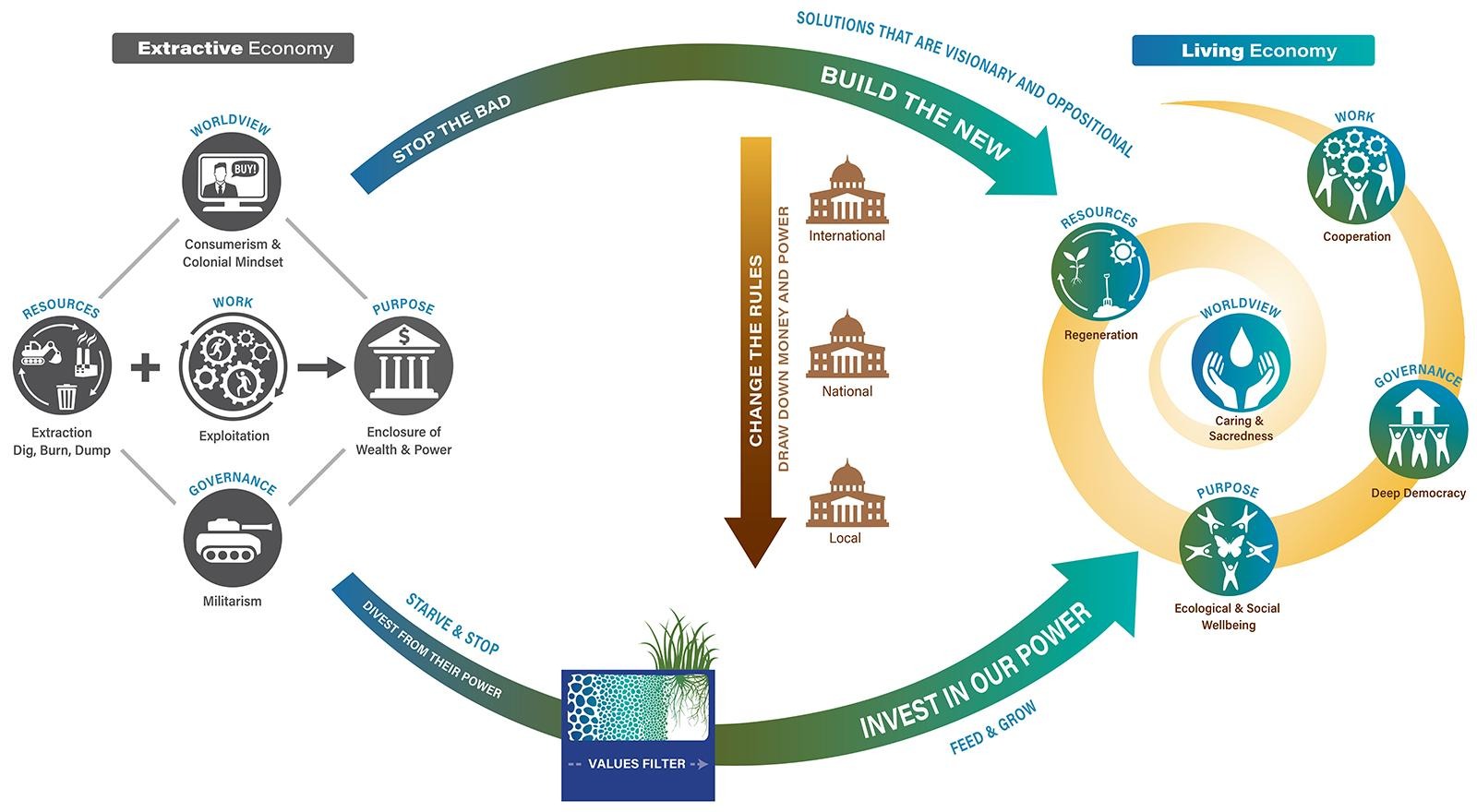
The Climate Justice Alliance (CJA) was formed in 2013 with the intention of uniting frontline communities and organizations to collectively fight for climate justice. Today, their more than 100 member organizations span states, territories, and Tribal Nations across the United States and Canada, representing communities that have long carried the heaviest weight of environmental harm: Indigenous peoples, Black, Latinx, Asian, Pacific Islander, and low-income white communities, many of whom live in close proximity to toxic facilities and polluting industries.
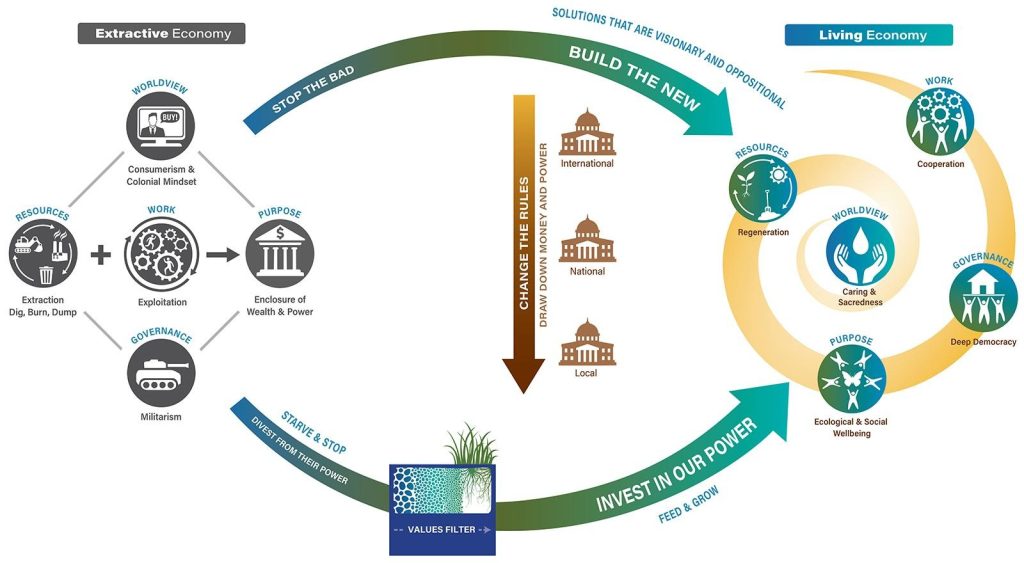
Wisdom of Frontline communities and leaders with the support of Movement Generation. Artwork by Micah Bazant.
What makes CJA distinctive is where its members began. Many did not start as climate organizations. They started as mentorship programs for local youth, community gardens feeding neighbors, and housing initiatives keeping families stable. Over time, these groups came to understand what their communities had long been living, the issues they were fighting and the climate disruptions they were experiencing were not separate problems but interrelated and with the same root causes.
A Shared Framework Across Difference
Our conversation began, as many do, with the weather.
Mark Chavez, CJA’s Storytelling and Brand Manager, was calling in from the greater Seattle area. Ofelia, who coordinates CJA’s Food Sovereignty Working Group, called in from Orlando, Florida. I joined the call from Lisbon, Portugal, although I previously lived in Jacksonville not long ago. Somehow, within the first few minutes, we were laughing about flash floods.
Mark noted that people in the Pacific Northwest have what feels like a hundred different ways to talk about rain without ever saying the word: mist, drizzle, marine layer. But Florida, he said, was something else entirely. The downpours he encountered there stopped him in his tracks. Ofelia and I knew exactly what he meant. In Florida, the rain doesn’t ease in. It arrives all at once, turns streets into rivers, resulting in stalled cars mid-intersection.
It was, in the best possible way, a ridiculous way to begin a conversation about climate justice. And yet it wasn’t ridiculous at all. Because the question underneath the laughter — why is water behaving differently than it used to, and who is least protected when it does — is precisely the question CJA has been organizing around for over a decade.
Holding together a coalition as diverse as CJA’s requires more than common cause. It requires a framework capable of identifying the root cause(s).
For CJA, that framework is Just Transition. It is a vision and a set of principles that identifies the extractive economy as the shared adversary beneath climate change, racial injustice, and food system failures. As Mark puts it: “It’s all about identifying the root cause of the climate crisis, which is also at the root of so many other issues we face as a planet: the extractive economy. Framing it this way also allows us to build towards something, regenerative economies, instead of always being against something.”
Within CJA’s Food Sovereignty Working Group, that shared framework takes on specific texture. Ofelia describes how the Just Transition lens opens space for a diversity of strategies rather than a single prescribed path. Land rematriation and long-term land stewardship are central, because food sovereignty, the group understands, is inseparable from the question of who controls the land. Cooperative models replace the isolation of individual farmers with shared resources and shared labor. Regenerative practices shape how communities care for the soil they work.
The working group also integrates political education as a core practice, drawing on resources from La Via Campesina and structuring brigade activities to include both hands-on work and strategic reflection. For newer organizations joining the alliance, it is often through these conversations that food sovereignty is named and claimed for the first time.
Six Pathways Toward a Just Transition
CJA’s vision is organized around six concrete pathways:
- End the era of extreme energy: fossil fuels, industrial agriculture inputs, and other extractive systems that pose direct risks to local ecosystems and communities.
- Reduce carbon emissions in line with what science requires.
- Build urban and rural economies that offer real alternatives through collective worker and community control of land, water, and food resources.
- Popularize a Just Transition framework toward local living economies that are regenerative, resilient, and rooted in place rather than extraction.
- Create a national climate jobs program that would generate ten million good, green, and family-supporting jobs.
- Develop infrastructure that protects cultural and biological diversity, creates local seed banks, and shields the communities most vulnerable to pollution, climate disasters, and economic disruption.
Credit: Image curtesy of Climate Justice Alliance
What Extractive Agriculture Makes Visible
In this April’s digest, Food First, presents climate not as the crisis itself, but as something that exposes and intensifies existing structural injustice. That framing did not originate in think tanks or policy circles. It came from communities.
“This framing came from communities who have been in survival mode for a long time and were looking for a way to thrive,” Mark explains. “Ultimately it comes down to working to confront root causes, repair harm, and build a better future. Those are all things people can agree on.”
In agriculture, extractive logic is especially visible. The global food system accounts for roughly one quarter to one third of global greenhouse gas emissions, according to FAO and peer-reviewed research. But that figure likely undercounts the true footprint of industrial agriculture specifically, which standard metrics often fail to capture in full: the emissions embedded in supply chains, the carbon cost of land use change driven by industrial expansion, and the post-farm consequences of a system built on scale rather than stewardship.
Meanwhile, the world’s smallholder farmers operate on just 12 percent of agricultural land yet produce roughly a third of the global food supply. Crucially, a far higher proportion of what smallholders grow goes directly to feeding people: research shows that large industrial farms divert significant portions of their production to biofuels, animal feed, and post-harvest loss, while small farms devote more of what they grow to food. The system concentrates land and power at the top while the communities doing the most essential work absorb the greatest risk.
Food policy has not kept pace. The U.S. Farm Bill, the primary legislative instrument shaping agricultural support, has long prioritized large-scale industrial producers over smallholders. Territories like Puerto Rico and Guam, whose communities are among the most climate-exposed, are routinely excluded from the conversation entirely. “Small places like Puerto Rico or Guam are not even mentioned in the Farm Bill or big bills like that,” Ofelia notes. “They tend to be forgotten because we don’t have representation in the federal government.”
Editor’s note: Puerto Rico and Guam do have representation in Congress through non-voting delegates — a resident commissioner for Puerto Rico and a delegate for Guam — who can participate in debate and committee work but cannot cast votes on the House floor. Ofelia’s point stands: without voting power, the priorities of island territories remain structurally marginalized in federal legislative processes.
The solution, she argues, is not a better Farm Bill. It is agrarian reform. We need a restructuring of who has access to land, what the state owes its people in terms of food security, and what infrastructure communities need to feed themselves without dependence on systems designed to extract from them.
Resiliency Hubs: Building the New
CJA’s strategic vision has always been organized around two parallel imperatives, to fight the bad and build the new. Increasingly, the building is taking visible form.
Over the past year, CJA has been supporting its member organizations in developing resiliency hubs. These are the people, practices, and places that meet a community’s needs outside the confines of the extractive economy. At least 20 hubs are currently in development across the alliance, at varying stages from visioning to brick and mortar.
The hubs share common commitments that include collective governance, just recovery, and food sovereignty. Beyond that, they take shape according to the specific needs of each community. Some serve as safe spaces for local organizations and centers for cooperative development. Others function as schools for political education, emergency resources, or homes for those in need of shelter.
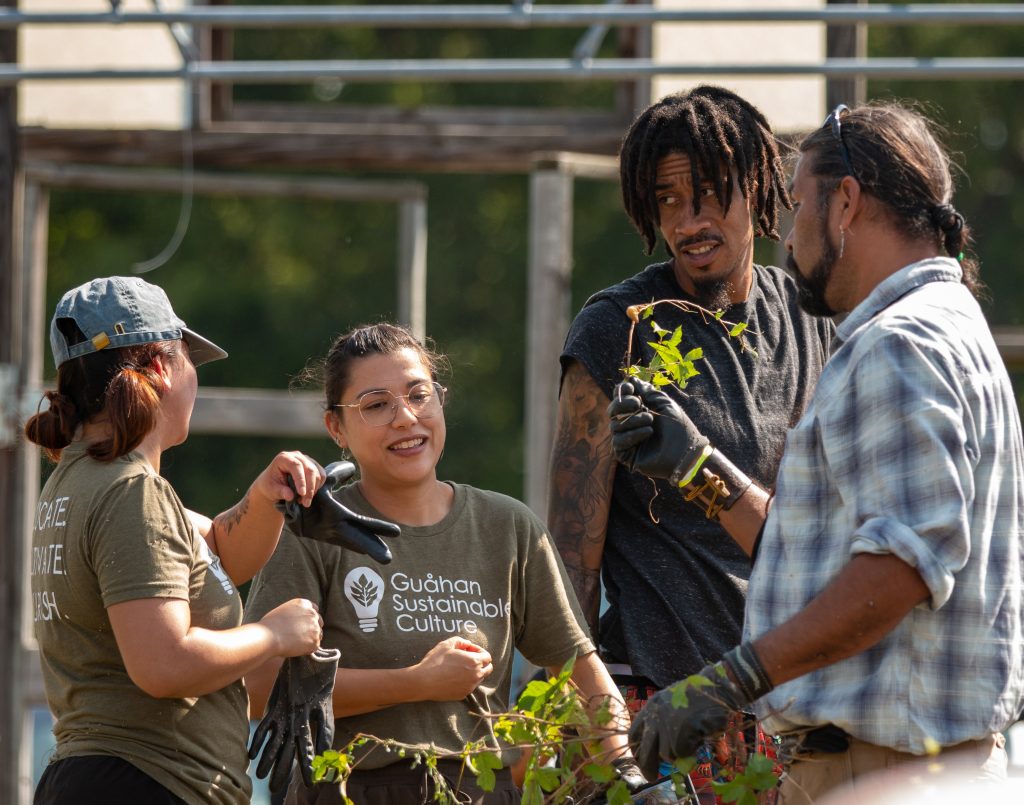
One example is the Guahan Sustainable Culture Resiliency Hub in Guam, built around a food forest that functions as both an emergency resource and an educational space for climate preparedness and recovery. In Miami, the Smile Trust operates out of their Freedom Lab community center in Liberty City, combining food distribution, disaster relief, and grassroots emergency response rooted in the principle that communities should not have to wait for government aid to take care of each other. In Detroit, the People’s Food Co-op centers food sovereignty. Each hub is distinct, yet each reflects the same understanding that resilience is not a technical solution but a community practice.
Mark describes the hubs as serving both practical and political purposes. These spaces may look familiar from the outside, but are quietly building something different on the inside. The nature of what happens within them is what matters. The examples above remind us that there is already so much being built: in food forests in Guam, cooperative kitchens in Orlando, community hubs in Detroit and Miami. Across geographies as different as a Pacific Northwest mist and a Florida downpour, people are finding each other and building something that can hold.
What Food First Sees in This Work
CJA’s work sits at the convergence of the themes this issue has been tracing. Most importantly they are asking their members what it takes to build systems that allow communities to stay and thrive rather than survive and disperse.
Their resiliency hubs are one answer to that question. So is their food sovereignty working group, which is quietly doing the work of political education, land stewardship, and cooperative economy-building across a network of communities that have been carrying this knowledge all along.
Food First looks forward to deepening our collaboration with CJA and supporting the work of their member organizations in the months ahead. If you want to learn more about CJA and their membership process and connect with their network, visit www.climatejusticealliance.org.